


Used Vintage Motorcycle Salvage Yards: A Buyer's Guide
Last Updated: November 27, 2026
Quick Summary
The best used vintage motorcycle parts shops combine deep, make-specific inventory with honest condition grading and a clear return policy, so you know exactly what you are buying before it ships. Look for a supplier that organizes inventory by era and marque and can tell you whether a part is original OEM, new old stock, or a used survivor piece.
- Confirm the OEM part number stamped on the component, not just the seller's description, before you pay.
- Ask for a photo of the exact part with today's date next to it to filter out unreliable vendors.
- Price the total landed cost, since shipping a complete engine or tank can rival the part price.
- Widen your parts search to 100-150 miles, because vintage inventory is sparse and often two states away.
- Match parts by part number first, then visual comparison, then measurement, since castings differ across model years.
Table of Contents
- What Should You Look For in Used Vintage Motorcycle Parts Shops?
- How to Inspect Used Motorcycle Parts Before You Buy
- Buying Used Motorcycle Parts Online: What to Verify
- Cheap Used Motorcycle Parts Online: Where the Real Savings Are
- Finding a New and Used Motorcycle Parts Shop Near Me: A Practical Checklist
- Vintage-Specific Inventory: Matching Make, Model, and Year
- Requesting a Part From Cycle Warehouse, an 85,000 Sq Ft New and Used Parts Store
- Frequently Asked Questions
What Should You Look For in Used Vintage Motorcycle Parts Shops?
The best used vintage motorcycle parts shops combine deep, make-specific inventory with honest condition grading and a clear return policy, so you know exactly what you are buying before it ships. Restorers often find that the shops that earn repeat business share the same handful of traits. Below, we break down what separates a genuine vintage specialist from a shop that just happens to have some old bikes in the back.
Inventory Depth and Vintage Specialization
Depth matters more than total volume. A shop with a million late-model parts but three shelves of pre-1970 components will not help a Norton or Indian restoration. Look for a supplier that organizes inventory by era and marque, and that can tell you whether a part is original OEM, new old stock, or a used survivor piece. Ask directly: do you stock complete engines, or just bolt-on accessories? The answer tells you how serious their vintage motorcycle parts operation really is.
Condition Grading and Return Policies
Condition grading is where most buyers get burned. A part described as "good used" can mean anything from lightly patinated to cracked and rewelded. Reputable shops photograph the actual item, note oxidation and surface marks, and state plainly whether a component is untested or needs a rebuild. Just as important is the return policy. Confirm in writing whether returns are accepted, who pays return shipping, and what window you have to inspect the part after it arrives.
How to Inspect Used Motorcycle Parts Before You Buy
Inspection starts before you pay: compare the listing photos against your own engine or frame, check part numbers, and ask for extra angles on any mating surface. Once the part is in your hands, inspect it in good light and look for the failures that photos hide.
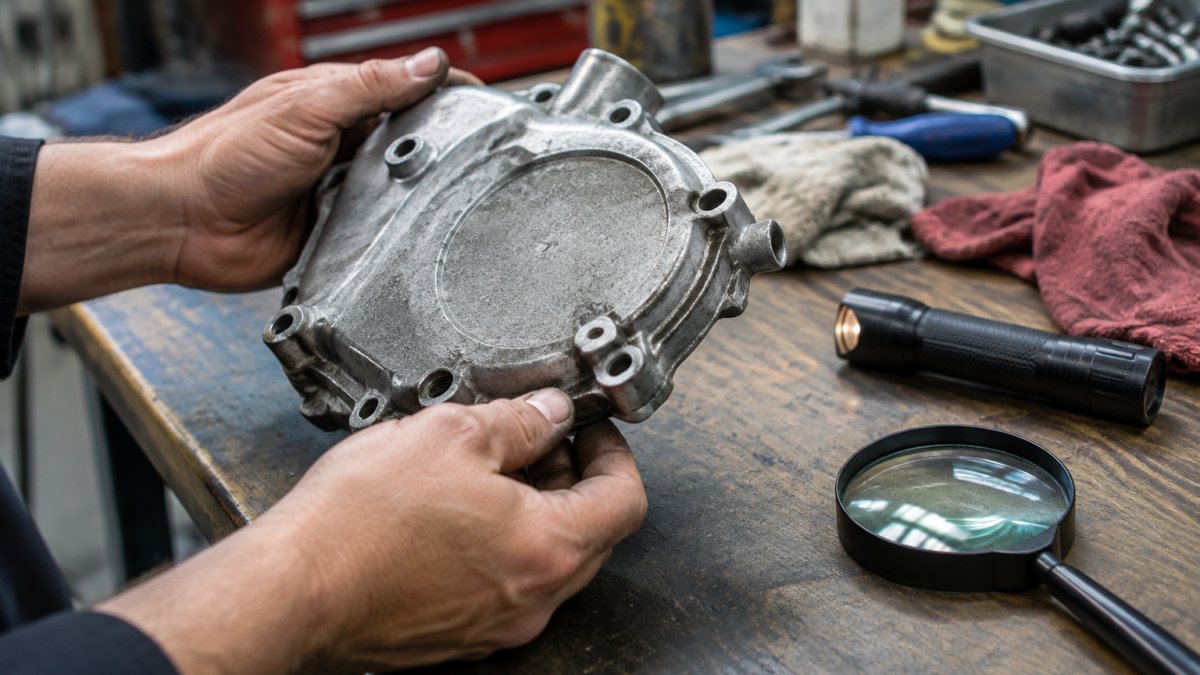
- Cracks and repairs: Check mating flanges and bolt tabs for hairline fractures or fresh weld beads.
- Threads and mounting holes: Run a bolt through every hole. Stripped threads are a common and costly surprise.
- Warpage: Lay a straightedge across sealing surfaces. A warped cover will leak no matter how good the gasket is.
- Corrosion depth: Surface oxidation is normal on vintage cast aluminum. Pitting that eats into a sealing surface is not.
- Wear items: On carburetors, check slide play and throttle shaft wobble. On wheels, spin the hub and listen for bearing noise.
A useful reference point is a real listing like this used Honda CB front wheel, which shows how a seller should describe honest rust and straightness.
Here are the specific failure points to check once a used part is in your hands.
| What to check | How to check it | Why it matters |
|---|---|---|
| Cracks and repairs | Look at mating flanges and bolt tabs for hairline fractures or fresh weld beads | Hidden fractures and rewelds are easy to miss in photos |
| Threads and mounting holes | Run a bolt through every hole | Stripped threads are a common and costly surprise |
| Warpage | Lay a straightedge across sealing surfaces | A warped cover will leak no matter how good the gasket is |
| Corrosion depth | Distinguish surface oxidation from pitting | Pitting that eats into a sealing surface is not acceptable |
| Carburetor wear | Check slide play and throttle shaft wobble | Reveals wear that photos hide |
| Wheel bearings | Spin the hub and listen for bearing noise | Catches bearing problems before purchase |
Buying Used Motorcycle Parts Online: What to Verify
Online purchasing adds a layer of risk that a walk-around inspection removes, so verification becomes your job. The gap most buyers fall into is treating a listing photo as proof.
Step 3: Get fitment caveats in writing. Ask whether the part is original OEM, new old stock, or a used survivor, and whether it has been test-fitted.
Step 4: Price the total landed cost before you commit. Shipping on a complete engine, a wheel, or a fuel tank can rival the part price.
Pay through a channel with buyer protection, and keep the listing photos and the seller's written replies saved.
Watch out: a seller who will not provide a part number, a dated photo, or a written condition note before payment is telling you how the transaction will go after payment.
Cheap Used Motorcycle Parts Online: Where the Real Savings Are
Real savings on cheap used motorcycle parts online come from buying complete assemblies and rebuildable cores, not from chasing the lowest sticker price. A used carburetor rack that needs a rebuild kit often costs far less than a rebuilt unit, and the rebuild itself is straightforward for a home mechanic.
Where else the savings hide:
- Complete assemblies: A full four-carb rack with linkage usually beats four individual carbs bought separately.
- Cosmetically imperfect parts: A fender with patina but no dents costs less than a refinished one and suits a rider, not a show bike.
- Untested electrical and fuel components: Priced low because they need work, ideal if you enjoy the rebuild.
- Local pickup: Many sellers let you collect in person and skip shipping on heavy parts entirely.
The trade-off is time. Budget for cleaning, testing, and possibly a rebuild before the part goes on the bike.
Finding a New and Used Motorcycle Parts Shop Near Me: A Practical Checklist
Searching for a new and used motorcycle parts shop near me works best when you treat the search as two problems: finding candidates, then verifying them before you drive or pay. Most buyers stop at the first step and waste a Saturday on a shop that only stocks late-model cruisers.
Build the candidate list. Start with a map search for "motorcycle salvage" and "motorcycle junkyard" plus your metro, then widen the radius to 100-150 miles, vintage inventory is sparse enough that the right part is often two states away. Cross-check each candidate against motorcycle forums and marque-specific owner clubs, where members name yards that actually stock pre-1980 parts. A yard that never appears in those threads is usually not a vintage source, no matter what its website says.
Verify before you travel. Use this checklist on every candidate:
- Confirm the yard stocks your make and era, not just late-model bikes, ask for a specific model year and listen for a real answer
- Call ahead and ask for the specific part by OEM number, not by description
- Ask whether inventory is indoor or outdoor, since weather exposure affects condition and price
- Confirm hours and whether walk-in browsing is allowed or parts are pull-only
- Ask about core returns, warranty terms, and whether returns are accepted on electrical parts
- Get the phone number and a direct contact name for follow-up
- Ask whether the yard ships and, if so, who crates heavy items
A yard that answers these questions clearly is usually a yard that grades its parts honestly. If a phone call feels evasive, that is your answer.
When the local search comes up empty, go national. For vintage parts, the nearest yard is often not the right one.
Plan the trip like a parts run, not a browse. If you do drive, call the day before to confirm the part is still on the shelf, bring your engine or frame numbers, and bring calipers and a straightedge so you can measure before you buy.
Watch out: a yard that quotes a price over the phone but will not hold the part for 24 hours is usually quoting from memory, not from inventory.
Vintage-Specific Inventory: Matching Make, Model, and Year
Vintage motorcycle parts shopping rewards precision. A part that looks identical across two model years can differ in casting numbers, mounting bosses, or internal clearances. Always match by part number first, then by visual comparison, then by measurement.
This is where a specialist's inventory earns its keep. Examples from our own shelves show the range: an original 1920s Indian Scout timing cover with correct legacy castings, a period Amal Monoblock carburetor for pre-unit British twins, and an OEM Buell parts catalog that lets an owner confirm exact fitment before requesting that part. Each listing states its condition and fitment caveats plainly, which is exactly what you should demand from any vintage motorcycle parts supplier.
Requesting a Part From Cycle Warehouse, an 85,000 Sq Ft New and Used Parts Store
The fastest way to get a hard-to-find component is to ask a specialist directly. Cycle Warehouse is an 85,000 sq ft store offering a large selection of new and used motorcycles and rare bike parts, covering Harleys, Indians, sportbikes, and custom builds, along with late-model, discontinued, and vintage components. Personalized assistance is available by phone or email for specific part or bike searches.
If you are shopping for a restoration project or a gift for a vintage enthusiast, a Cycle Warehouse gift card is a convenient option for motorcycle enthusiasts.
Restoring a vintage bike often means searching for parts that are no longer in catalogs. Cycle Warehouse is an 85,000 sq ft store stocking an extensive selection of new and used late-model, discontinued, rare, and vintage parts, specializes in used fenders and paint sets, and offers personalized help by phone or email for specific part searches.
Frequently Asked Questions
How do I find vintage motorcycle parts for a restoration?
Start with the part number, not the part name. Factory numbers like Honda's 61101-273-310 let you cross-reference superseded numbers and confirm fitment across model years. Then check motorcycle parts specialists that list vintage inventory by make, model, and year rather than generic categories. Ask for photos of the actual part, including casting marks and mounting holes, and confirm the shop will hold the item while you verify measurements against your frame or engine casing. A specialist that answers fitment questions by phone saves weeks compared with blind marketplace searching.
How can I tell whether a used motorcycle part is in good condition?
Look for structural problems first: cracks, welds, and repaired mounting tabs are dealbreakers on load-bearing parts like fenders, hubs, and engine covers. Surface oxidation and oil staining are normal on vintage pieces and usually clean up. Ask for close-up photos of mating surfaces, bolt holes, and any cast lettering. On carburetors, check that slides move freely and that the rack linkage is intact. Untested assemblies, like a used Keihin four-carb rack, should be priced as rebuildable cores, not as ready-to-bolt-on parts.
What should I check before buying a motorcycle salvage part online?
Confirm four things: the exact part number or casting mark, the seller's condition description, the return policy, and the shipping cost on heavy items. A fender or fuel tank can add significant freight, so ask for a quote to your ZIP code before committing. Read the listing photos at full resolution for shelf wear or scratches, especially on new old stock pieces that sat in storage for decades.
Are used motorcycle parts worth buying for a vintage restoration?
For discontinued and rare components, used parts are often the only path. Used original parts can keep a restoration correct in a way reproduction parts may not. The trade-off is condition risk, so buy from sellers who photograph the actual part, describe flaws plainly, and accept returns. For wear items like tires and carburetor internals, weigh the savings against rebuild labor before committing.
Can I buy just one small part from a donor bike without buying the whole machine?
Yes. Motorcycle parts specialists routinely break down donor bikes and sell individual components, from a single engine cover to a carburetor rack. Call or email with the part number, the make, model, and year, and a photo of what you need. Expect to pay for the part plus shipping, or arrange local pickup if you are close enough to collect it in person.
